Traditional clothing hides the dancer from our cameras, so everyone danced twice
28 November 2026 · Cochabamba · Lab note
Paqarina, a Mozilla Fellowship project, is an AI model that learns Bolivian dances from the people who dance them and generates them for an avatar and a humanoid robot. On 25 November eight dancers danced the same music twice in Cochabamba, Bolivia: first in their own clothes, then in traditional clothing. With traditional clothing almost nothing of what the cameras capture is good enough to teach the model, and under a pollera nothing is, so we started to teach a small model to read the body under the clothes.
Everyone danced twice
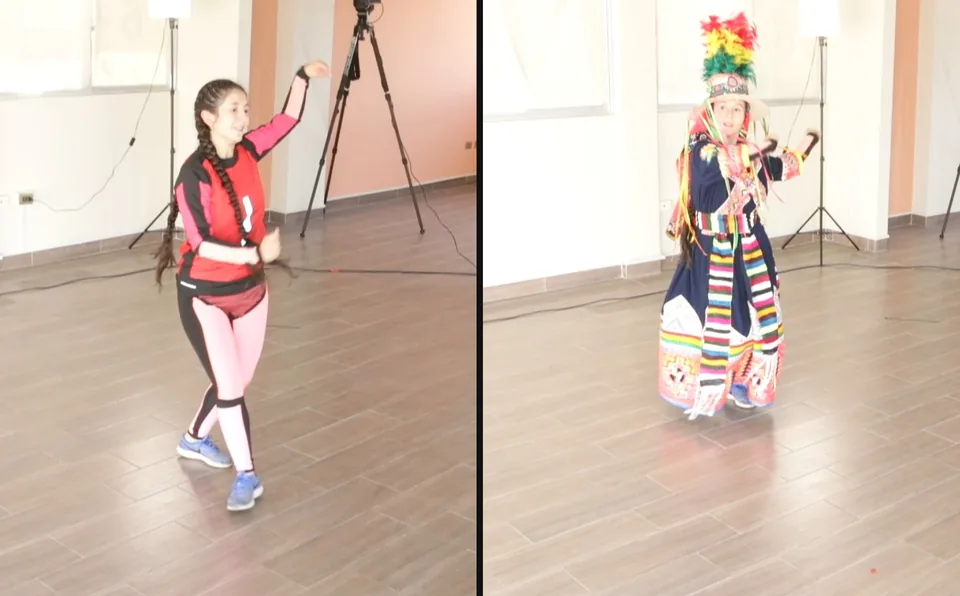
The dances of our community are danced in their clothing. A tinku has its helmet and its feathers. A pollera turns with the dancer.
Our cameras need the opposite. Four cameras find 26 points on a body, and they find them best on a body in tight clothes.
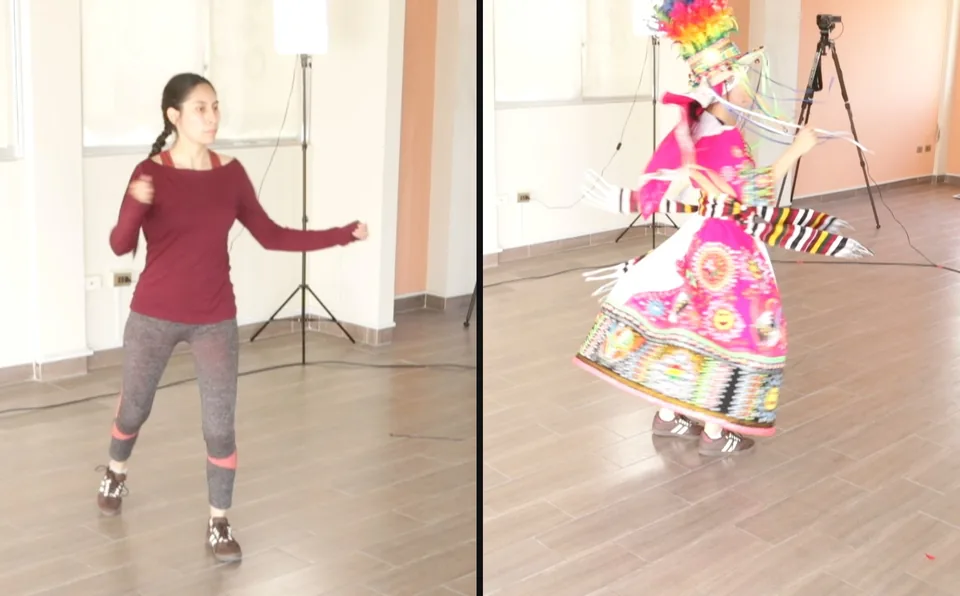
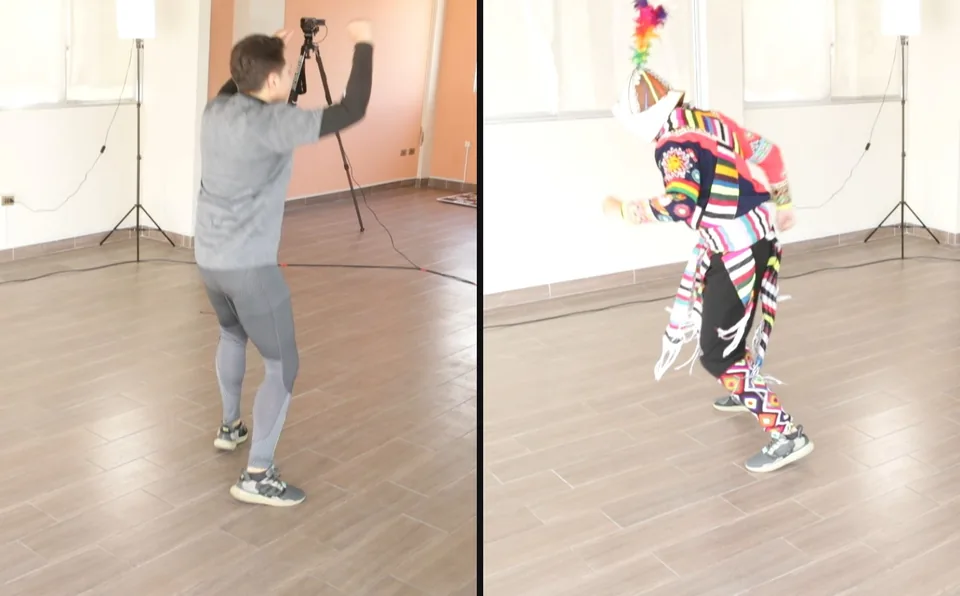
So on 25 November we asked for both. Eight dancers came. Each one danced a mix of kullawada, tinku and suri sicuri, 174 seconds long, in their own clothes. Then they changed, and danced the same mix again in traditional clothing.
Sixteen solos, the same music every time.
Why twice
The first pass is the answer sheet for the second.
It is the same person, the same music and the same shoes. So the first pass tells us how long each bone of that dancer is, and what the body was probably doing at each second of the music.
It also tells us who is who when the clothing covers everything. We matched each dancer to their second pass by the length of their bones, and by their shoes.
What the clothing does to the capture
Before a dance teaches the model, it passes a check. We cut it into windows of six seconds, and a window passes only if the bones keep their length. An arm that stretches by ten centimetres is not dance, it is a mistake of the cameras.
Each solo has 59 windows.
| Clothing | Windows that pass, of 59 | Frames with a broken bone |
|---|---|---|
| Own clothes, eight dancers | 34 to 54 | 5 to 9 % |
| Traditional clothing with trousers, five dancers | 2 to 14 | 16 to 28 % |
| Traditional clothing with a pollera, three dancers | 0 | 41 to 51 % |
In their own clothes the eight dancers left 356 windows. In traditional clothing, 35.
We looked for the reason. The cameras place the hip about 3 centimetres too high, at the waist of the clothing, and they place the knee on the straight line from hip to ankle. All four cameras make the same mistake, so they agree with each other, and nothing in the capture warns us.
What stays true under a pollera
One thing does not change. The shoulders of a dancer are at 118.6 centimetres in a pollera and at 119.2 in own clothes. For another dancer, 127.5 and 128.5.
So the body goes down just as much. The knees are bending under the cloth. The cameras do not see it.
A small model that reads the body under the clothes
We trained a small model on 202 minutes of clean dance from our archive. We hide the hips and the knees from it on purpose, and it learns to place them by looking at the rest of the body.
The sixteen solos do not train it. They are its exam.
First the exam with own clothes, hiding the same points: it puts the knees within 3.8 centimetres of where they were.
Then the pollera. The hip comes back to its height: 71.8 centimetres against 72.1 in own clothes, where the cameras alone said 75.1. The leg that stands is right.
The leg that lifts is not. A lifted foot stays inside the cloth, and the cameras guess it near the floor: 16 centimetres high where it was 31. So that knee comes out half as bent.
What cameras cannot give
We tried to recover the lifted foot from the cameras and could not. Imagining it from the rest of the body is not measuring, and we will not teach the model legs that we imagined.
Two things would measure it: small sensors on the ankles under the clothing, or a short rehearsal skirt for the second pass.
Until then, what was danced in own clothes went into the model, and what was danced in traditional clothing waits in a folder of its own.
It still holds a lot: the trunk, the arms, the height of the hips, the leg that stands, the path across the floor and the turns.
What we ask the robot to do
For the robot we work out 29 angles for every instant of a dance. Twelve of them belong to the legs.
Under a pollera we cannot measure the leg that lifts. So no dance captured in traditional clothing has been asked of the robot.
The first pass of the same dancer, in own clothes, can be.
Use this note as a source
To cite it: Violeta Ayala, Traditional clothing hides the dancer from our cameras, so everyone danced twice, United Notions Film, 28 November 2026, unitednotions.film/research/traditional-clothing-hides-the-dancer-from-our-cameras-so-everyone-danced-twice.
The whole note is also a plain text file. A person can read it, and it can be given to an AI as a source.
Thanks
Paqarina is a Mozilla Fellowship project.
Thanks to the eight dancers of 25 November, who danced everything twice. The dances belong to our community. Motion capture: Dan Fallshaw.
What the record shows
| Measure | Value |
|---|---|
| The session | 25 November 2026, eight dancers, four cameras |
| Solos | 16: each dancer in own clothes and in traditional clothing, the same mix of 174 seconds |
| Windows of six seconds in each solo | 59 |
| Windows that pass the check, all dancers | 356 in own clothes, 35 in traditional clothing |
| Where the cameras place the hip under traditional clothing | about 3 centimetres too high |
| Shoulder height, pollera and own clothes | 118.6 and 119.2 centimetres; 127.5 and 128.5 |
| Dance the small model learned from | 202 minutes, none of it from this session |
| Its exam in own clothes | knees within 3.8 centimetres |
| Hip height under a pollera | 71.8 centimetres with the small model, 72.1 in own clothes, 75.1 from the cameras alone |
| The lifted foot under a pollera | read at 16 centimetres, where it was 31 |
| What went into the dance model | only what was danced in own clothes |
| Joints of the robot | 29, twelve of them in the legs |
What remains open
How to measure the leg that lifts under a pollera. Sensors under the clothing are the next thing to try.
There is no honest check yet that says when a body read under the clothes is good enough to teach the model.
The clothing of the kullawada and of the suri sicuri has not been captured. When it is, each dancer will dance twice again.
The sensors are the next step.
A lab note by Violeta Ayala, written at koa.xyz, our lab in Cochabamba, Bolivia. It is also published by United Notions Film. Violeta Ayala directs sala.red, which investigates technology in Bolivia.
To cite it: Violeta Ayala, “Traditional clothing hides the dancer from our cameras, so everyone danced twice”, koa.xyz, 28 November 2026, https://koa.xyz/research/traditional-clothing-hides-the-dancer-from-our-cameras-so-everyone-danced-twice/