Huk
Violeta Ayala is expanding Huk into a collective intelligence model, where Indigenous AI, dance, affective computing and ecology meet, with Mila and Abundant Intelligences in Montreal.
Huk the Jaguaress is one work inside Huk.
Huk's world: from a body to a creature
Huk's creatures move with a person. One OAK-D depth camera reads the performer: 33 points of the body, 468 of the face and 21 of each hand, thirty times a second. Each frame travels as a small packet to Blender, where the creature's bones follow. From the camera to the bone takes between 33 and 100 milliseconds.
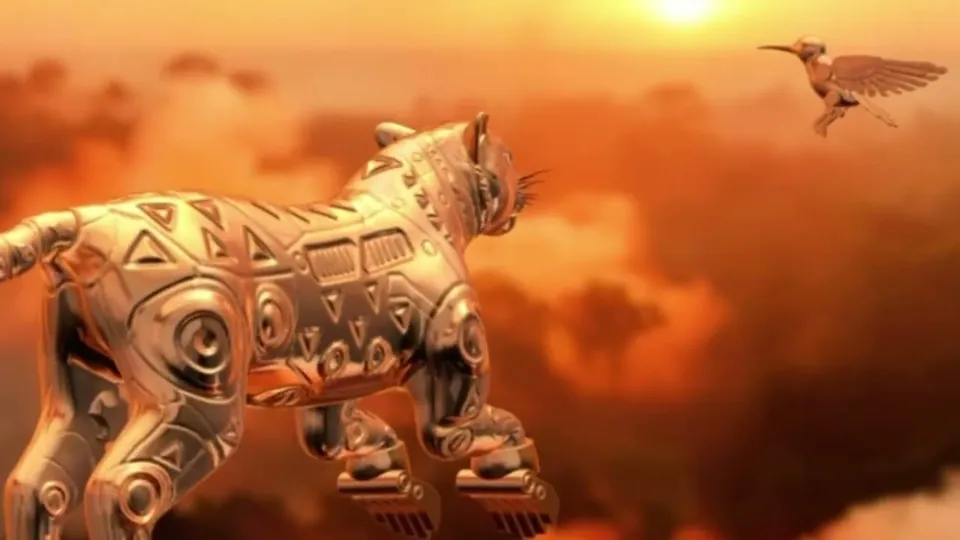
Three creatures, three bodies. The Drosera, a carnivorous plant, came first: each finger of the performer moves one of its tentacles. The Colibrí, a hummingbird, flies with the palm and moves its wings with the fingers. The Condor, with wings of more than three metres, takes the whole body: the face drives its head, its blinks and its beak, the arms become its wings, each finger a primary feather.
We call it somatic interspecies translation. A plant and a bird have other bodies than ours, so every mapping is a reinvention. Ch'ixi logic guides it: the performer never disappears into the creature. Both stay visible, in layers.
The whole system runs on one camera and one computer, so it can travel to a community without an institution behind it. The ecosystem grows toward 21 creatures.
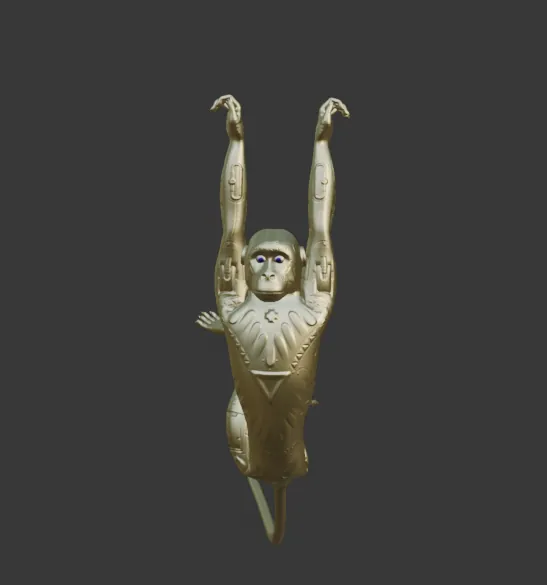
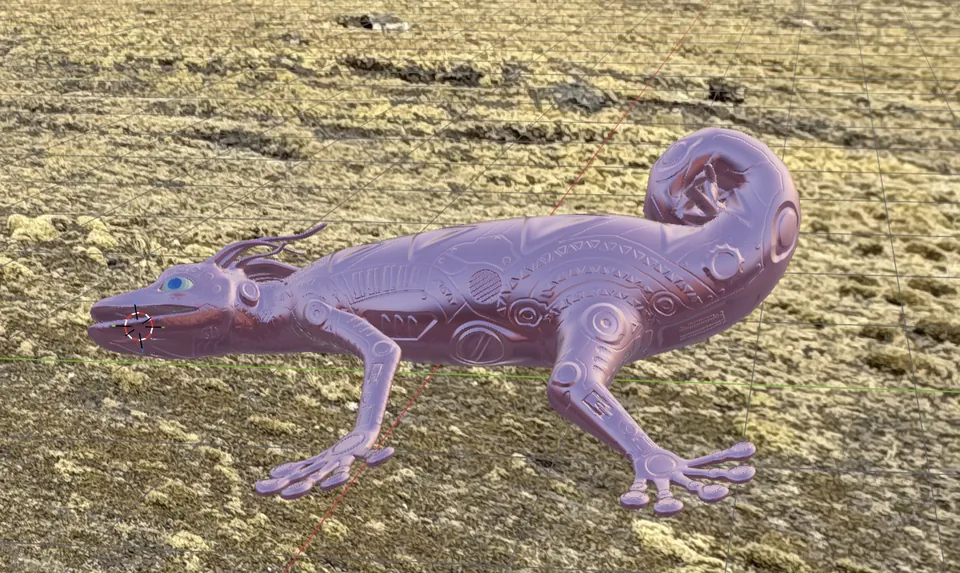
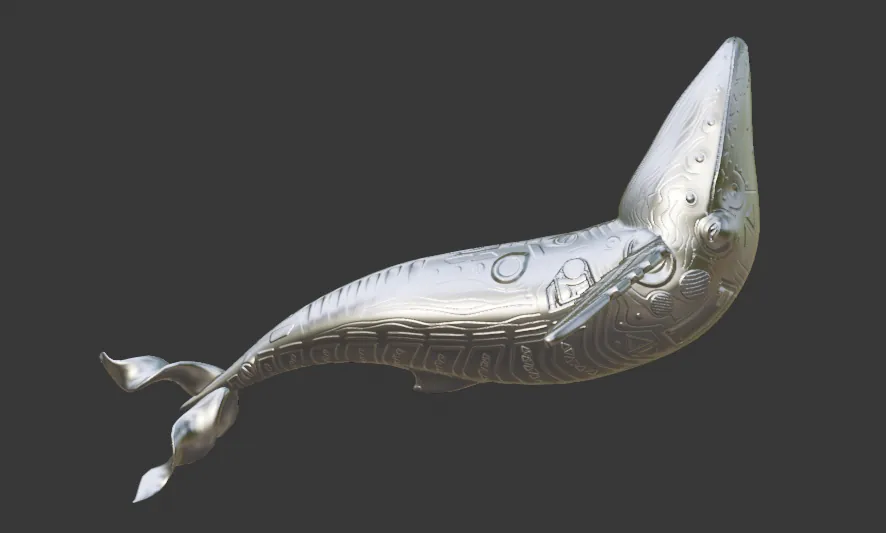
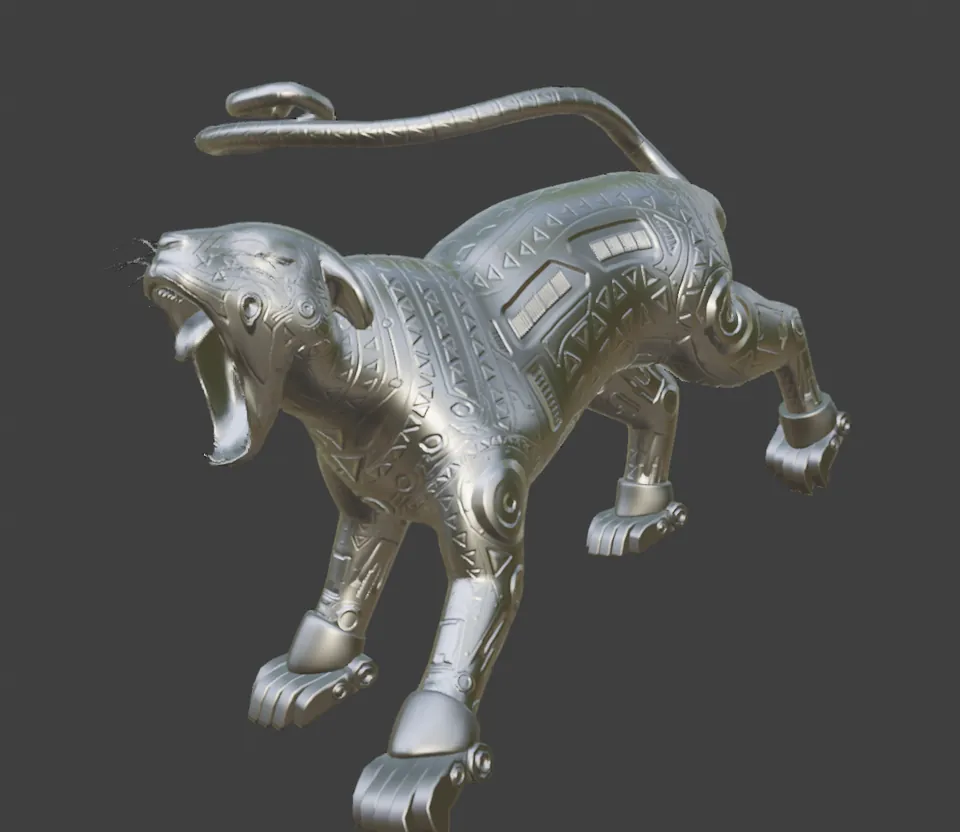
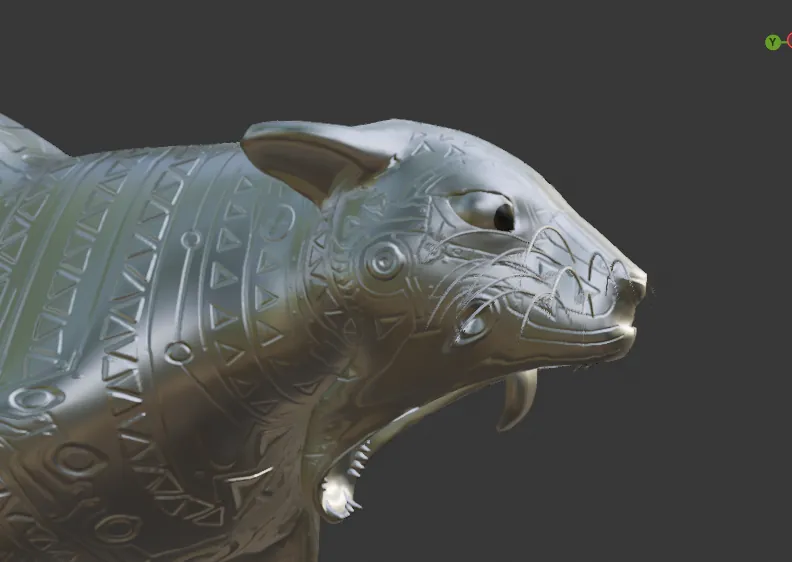
May and June 2026: the macaque, the gecko, the silver whale and the jaguar. Each one is rigged to move live with a performer's body.
Violeta Ayala and Brian Condori, United Notions Film, February 2026. Funded by Abundant Intelligences.
Huk the Jaguaress
Chronicles of building Huk
In 2024, in a twelve-week art and AI residency at Mila in Montreal, Violeta Ayala built Huk the Jaguaress, the first work of Huk. These are pages of her process book, with what she told XR Must in March 2025.
The idea
The first sketch has two paths. One is a robot jaguaress who describes what she sees, like the Spanish chroniclers who wrote down the Americas as they saw them. Seeing is contextual, cultural and personal. The other is a set of animals moved by hand that also challenge and disobey, with minds of their own, in a world made live by AI.
Logline: until the jaguaress tells her own story, the story of the hunt will always glorify the hunter.
Born from fire
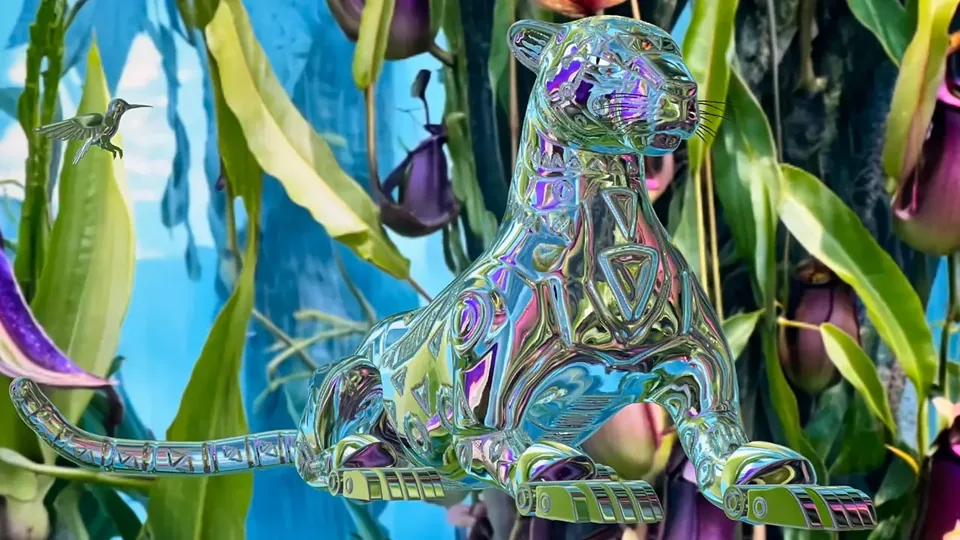
Huk the Jaguaress comes from the fires that burned the Bolivian Amazon in 2019. That year Violeta wrote a children's screenplay about a jaguar mother and her two cubs. The screenplay gave Huk her voice. Sometimes she tells visitors about her daughter, Nina.
Perception, brain, reaction
Violeta Ayala and Yasmeen Hitti built Huk as an algorithm in three parts. Perception reads the room: who is there, how close, what they wear. The brain holds her personality, maps what she perceives to an emotion and chooses an action. Reaction is her voice, her films and her light.
Several AI models work as one system and move her through the stages of a life, from youth to old age. She sees through a small robotic camera, follows bodies in real time and chooses whom to answer, up to twenty people. What she says never repeats. She makes short films live and paints the smaller jaguars with projected light.
The system on one sheet
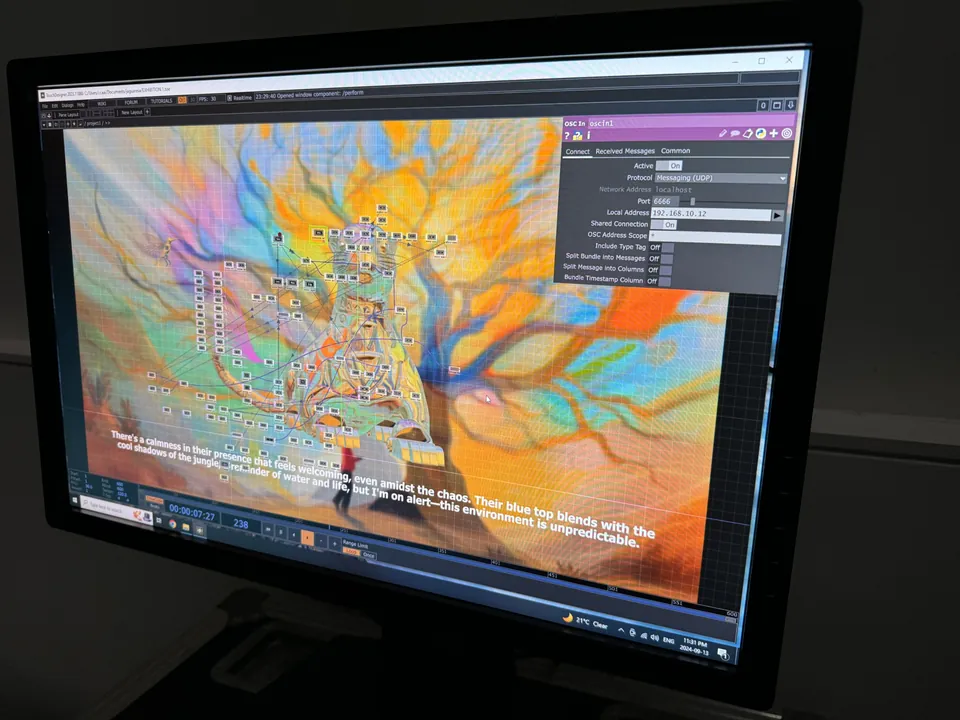
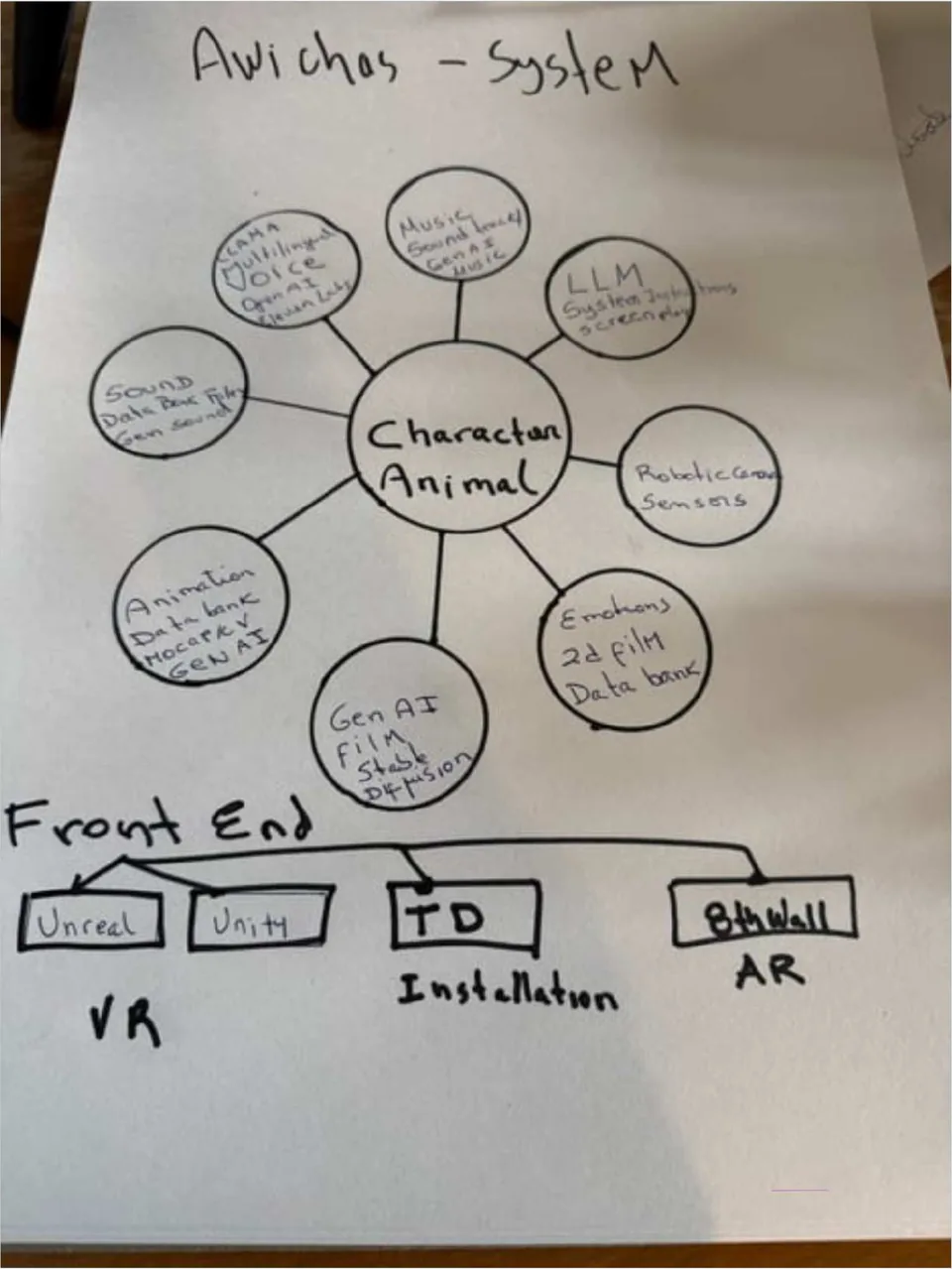
A character animal stands in the centre. Around it: a voice, a sound bank, a language model with its system instructions and the screenplay, the robotic camera and its sensors, a bank of emotions and films, film generated with Stable Diffusion, and an animation bank made with motion capture. Below, the front ends: Unreal or Unity for virtual reality, TouchDesigner for the installation, 8th Wall for augmented reality.
Ten emotions for a body
Love and hate. Rain and fire. Warm and cold. Peace and war. Past, present and future. Passion and indifference. Fight and flight. Fear and reassurance. Surreal and real. Light and dark. Jaguars are territorial.
Each emotion has a gesture in the animation bank. Love opens her narrow eyes; hate knits her brows. Fear lifts her whiskers; reassurance lowers them. Dark is a blink, one eye and then the other; light opens them one by one. Fight lifts her neck and head; flight turns them aside.
A personality
The first instructions, July 2024: she is a jaguar of the Amazon, irreverent, playful and independent. She receives written descriptions of people, reads their warmth, gestures, posture, closeness, clothes and colours, and answers with an emotion and two sentences. Her emotions were seasons and times of day. The memory experiments began on 15 July 2024.
What she keeps
Huk keeps no memory yet, by choice. The camera turns each person into a short description, such as a black t-shirt, brown trousers and glasses. Only those words travel to the language model. The photograph is deleted at once.
Within reach
The depth camera cost US$300 and does more for motion capture than a US$3,000 suit. The first prototype cost US$128. The materials: a 3D printer and metallic PLA, a person sensor, an OAK-D depth camera, motor controllers and motors, thermal printers and an NVIDIA Jetson Orin Nano.
Her body
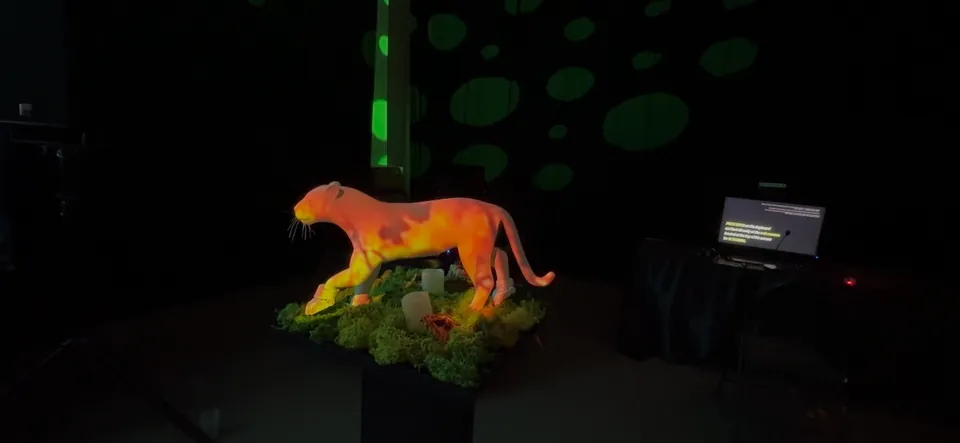
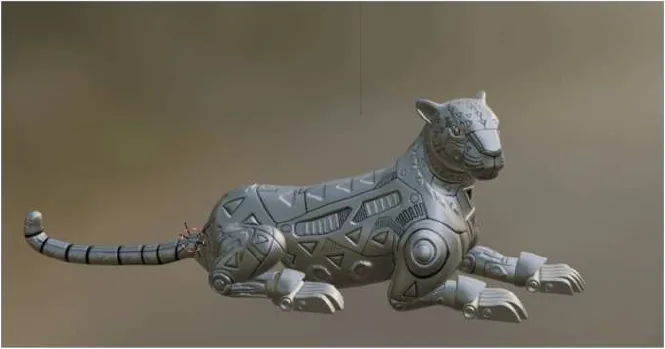
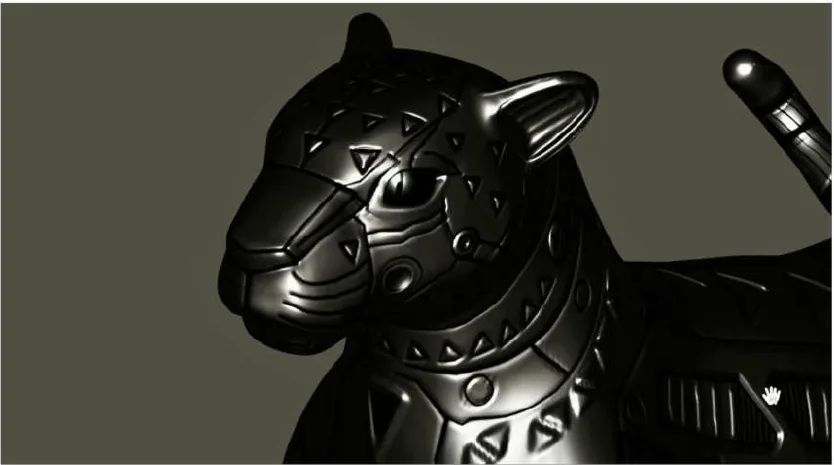
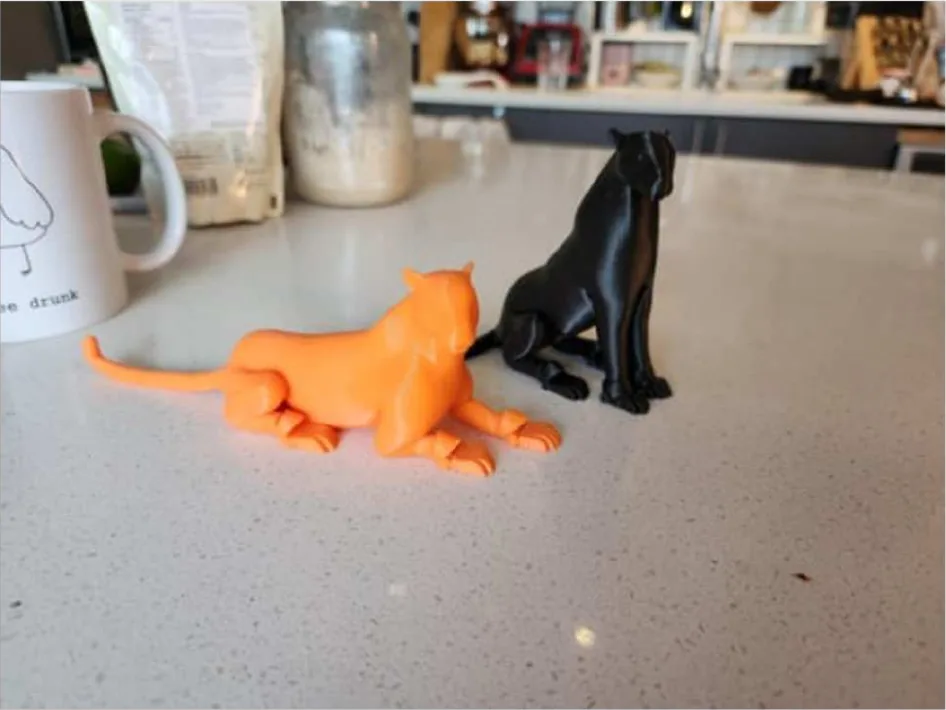
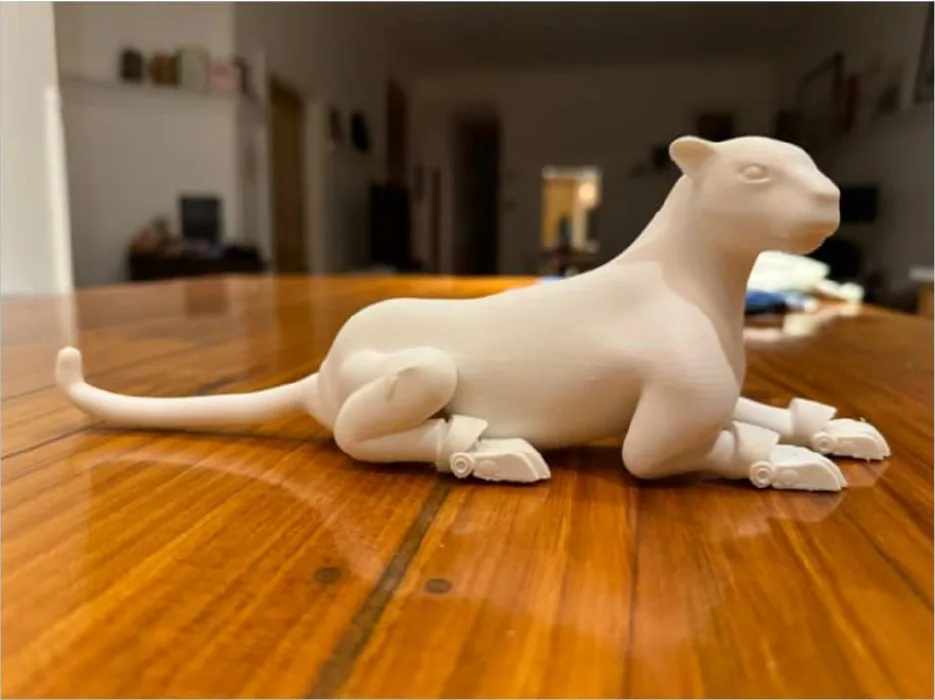
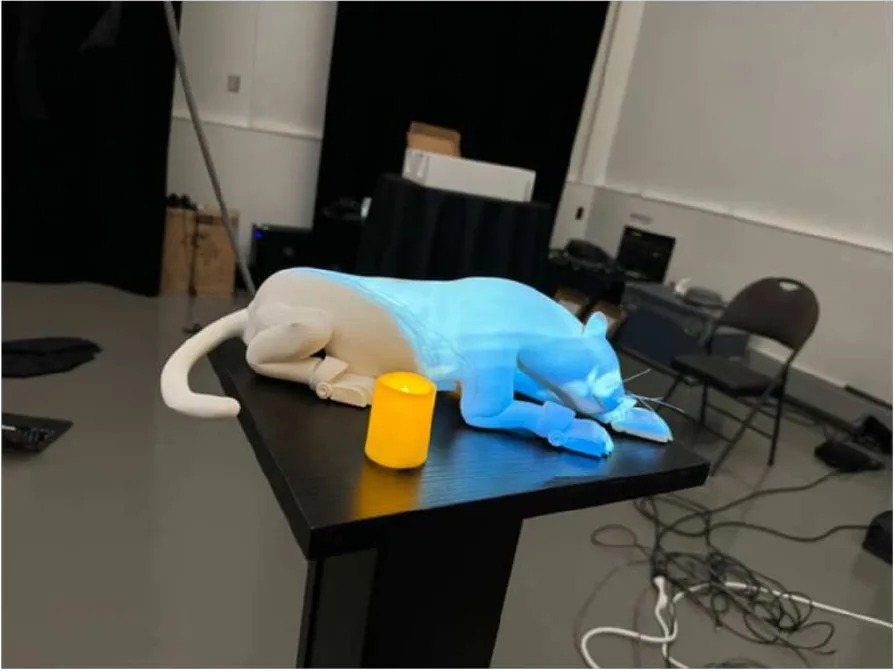
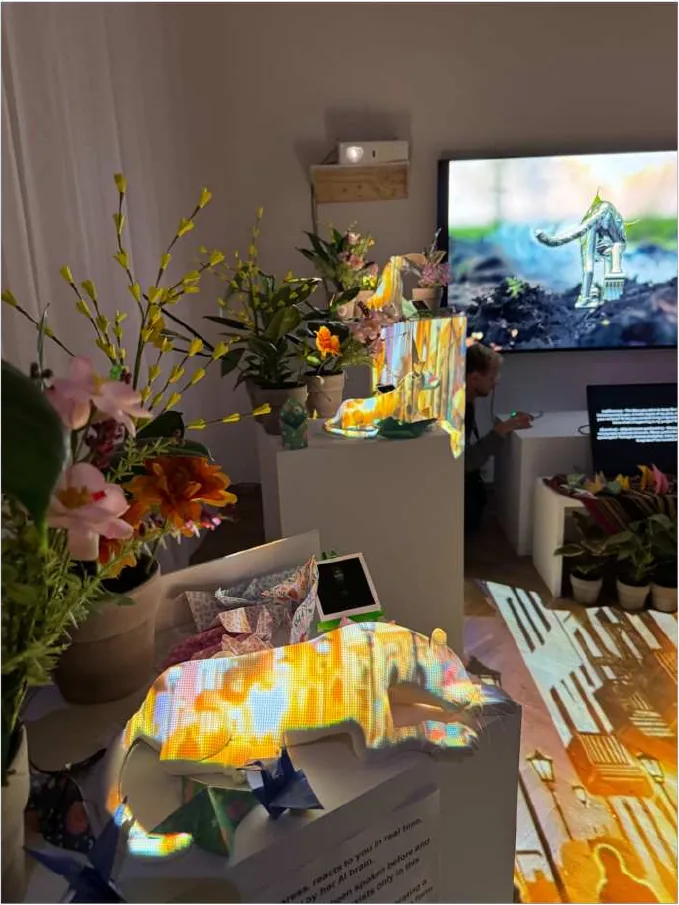
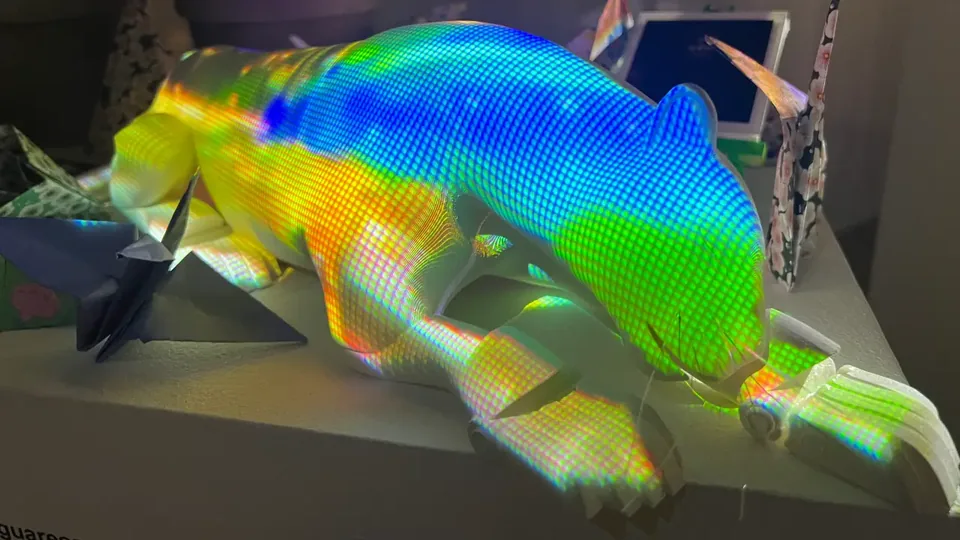
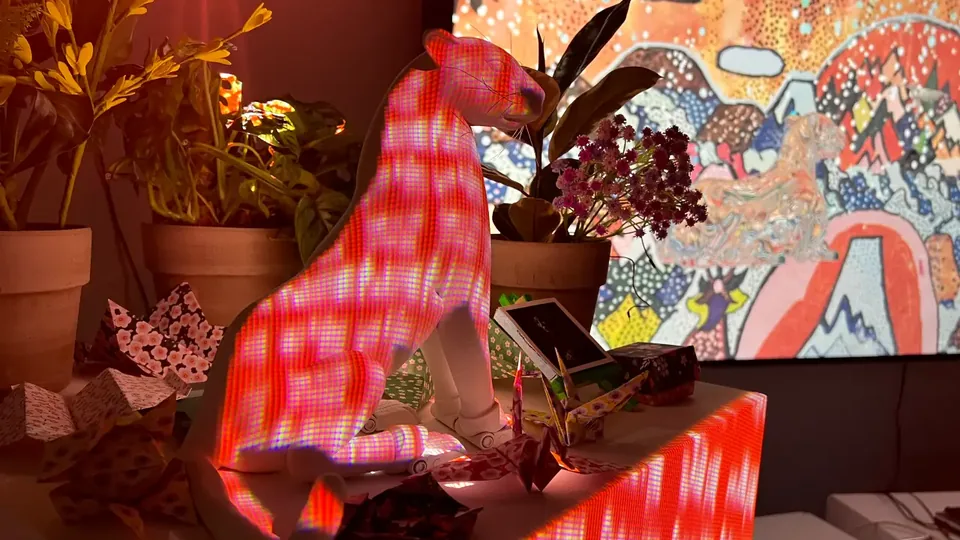
She began as two jaguars, one golden and one silver. The silver one went into Blender and came out articulated, with an electroplated skin. The prints: orange and black in July 2024, white and articulated in August, and in October the first light projected onto the printed body.
The room
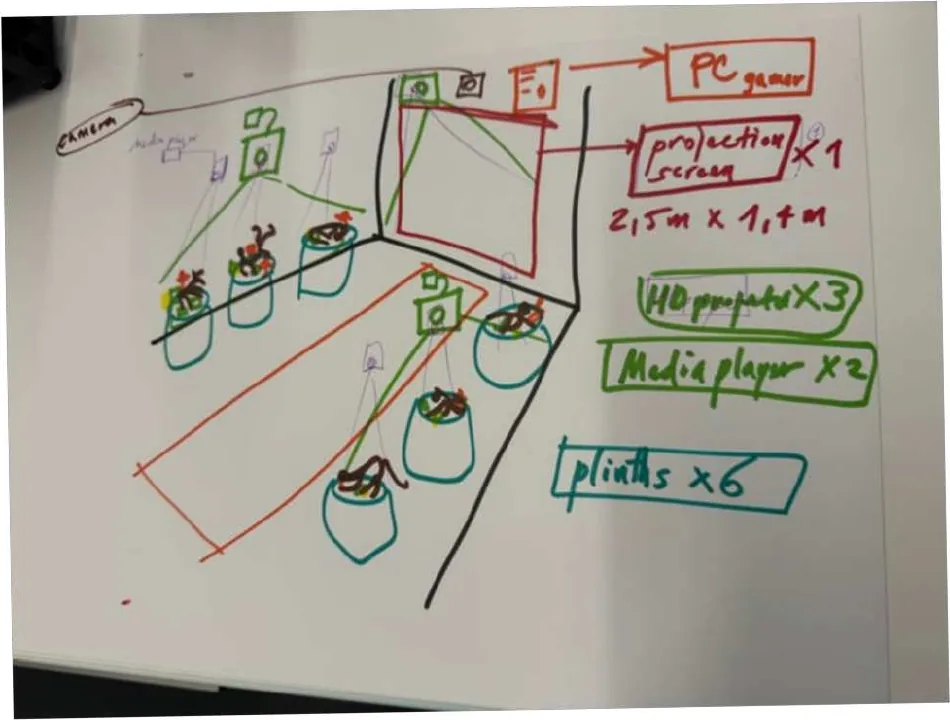
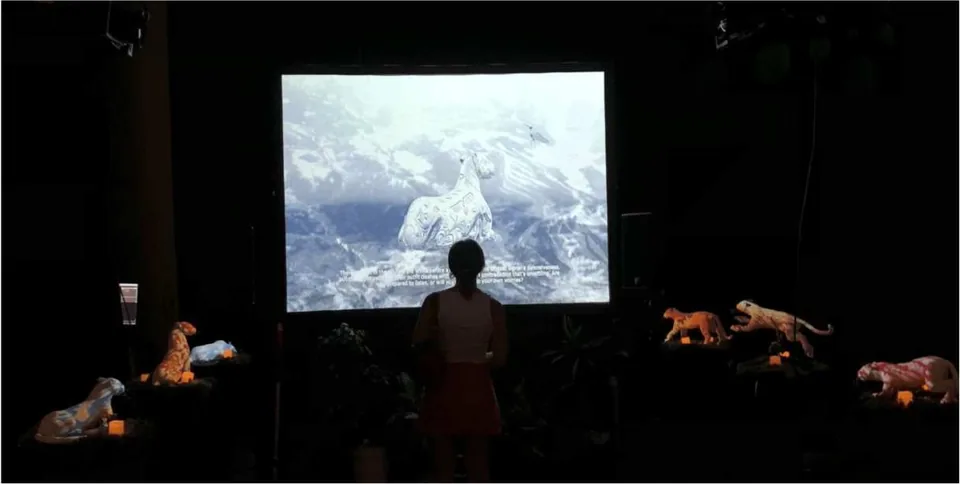
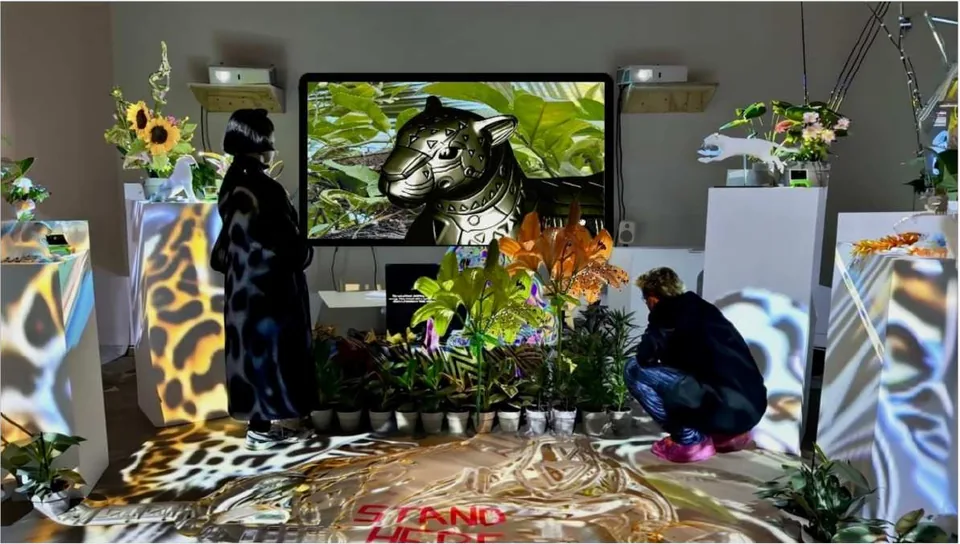
The plan: one computer, a projection screen of 2.5 by 1.4 metres, three HD projectors, two media players and six plinths. Stable Diffusion and TouchDesigner make the images; MadMapper fits them to the jaguars. Huk the Jaguaress opened in Montreal in 2024 and travelled to Copenhagen and Paris in 2025.
Instructions in the open
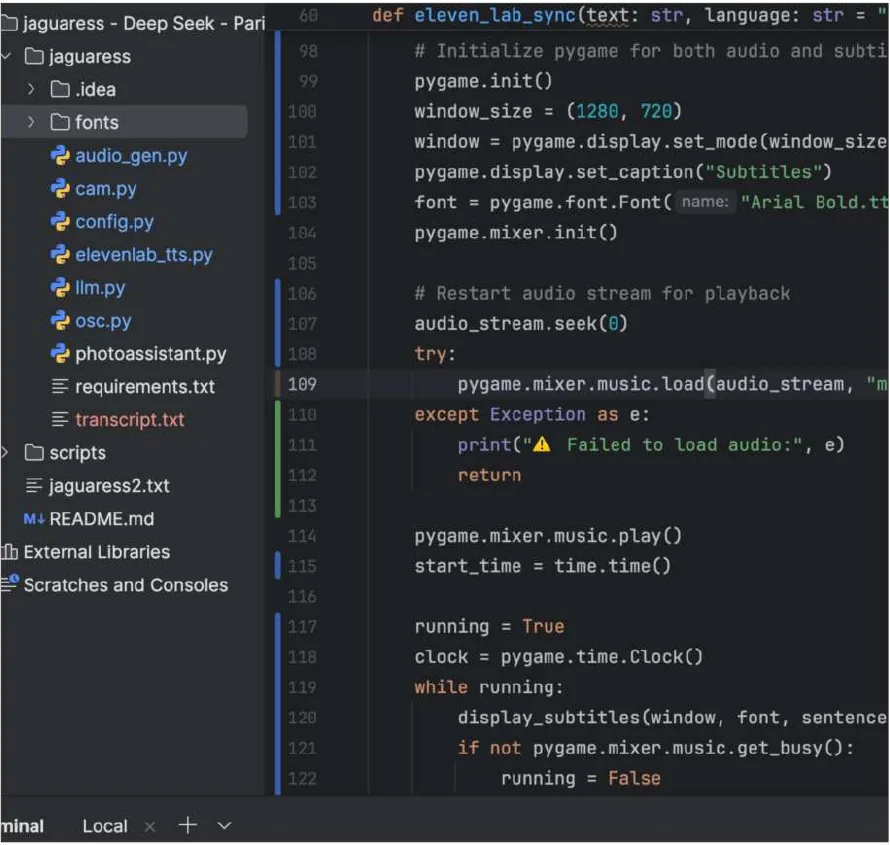
Violeta wrote Huk's system instructions with Dan Fallshaw and Yasmeen Hitti, across several models: OpenAI, DeepSeek, Claude and ElevenLabs. She argues that the system instructions of every AI should be public.
The team
Violeta Ayala. Yasmeen Hitti, creative AI systems engineer: she joined the systems, made the soundtrack and tracks the data for research. Dan Fallshaw and Milton Riaño, interactive media developers. Rohan Banerjee, AI researcher. At Mila, Eilif Muller worked with Violeta on memory and interaction.
Next: sensors that read the plants around her, from Yasmeen's research on plant signals, toward an AI that is more than human.
Source: Violeta Ayala at CPH:DOX INTER:ACTIVE, interview by Agnese Pietrobon, XR Must, 31 March 2025